
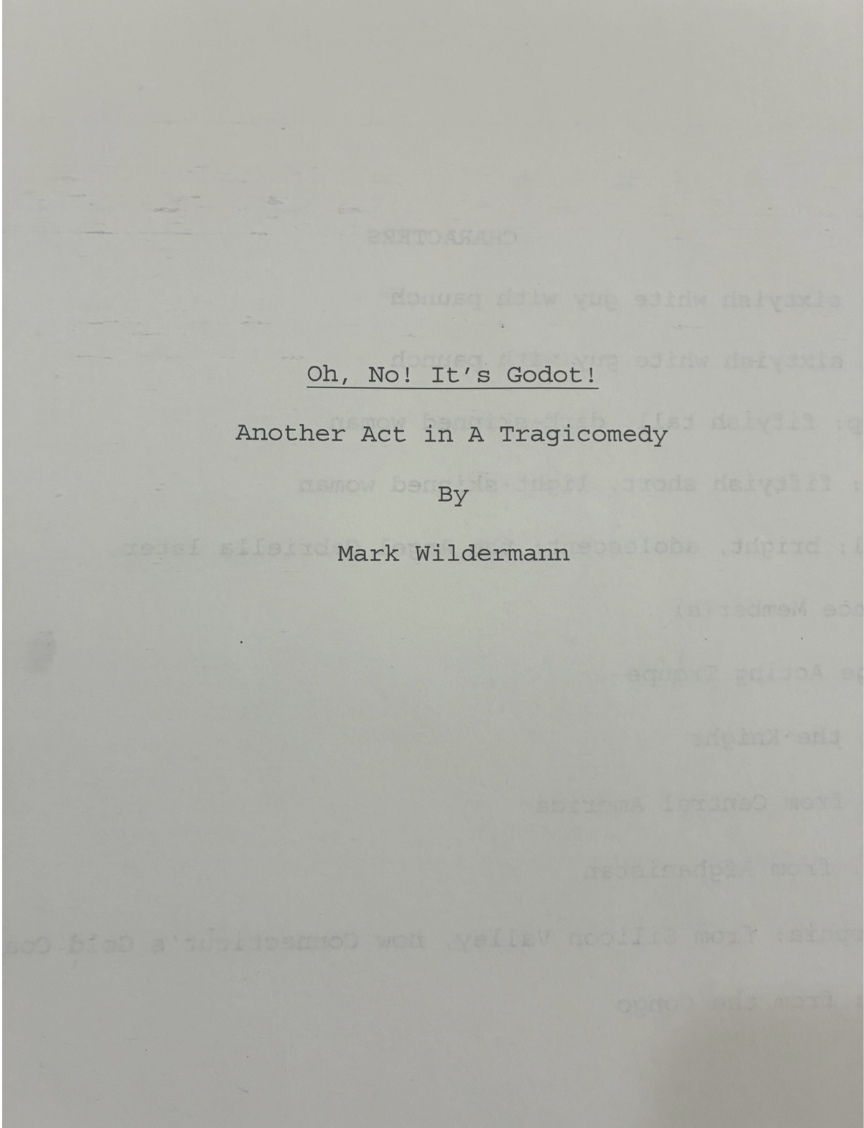
Synopsis of Oh, No! It’s Godot!
Ogog and Idid have made their living — made a killing — off Waiting for Godot by means of visiting professorships, lecturing, book deals, and motivational speaking conferences. Their reputations and credentials having been jump-started and promoted by their having believed, since the dawn of their reasoning, and having convinced a gullible academic and non-academic world to believe, they are the sons of Estragon and Vladimir.
Second thoughts and feelings of guilt have seeped into their consciousnesses just when Oz-zop and Ykcul intrude upon their messy city apartment. These ‘daughters of Godot’ confront these ‘Godot bastards’ with their true lineage, the consequences for the culture they’ve created and profited from, and Godot’s effect on the women who, until now, were left backstage, way backstage.
An angel and an international teenage acting troupe that includes a knight offer hope and compassion when waiting is no longer an option.
Back in 1956, Irish critic Vivien Mercier said of Samuel Beckett’s two-act masterpiece, Waiting for Godot, that it was “a play in which nothing happens twice.”
I was quite wonderfully immersed for many years in Yeats, Joyce, and Beckett. I had two fine professors at the University of Connecticut, J. D. O’Hara and K. Narayan Kutty, who both interviewed Beckett in Paris. Narayan became one of my dearest friends. He told me of some personal things shared between him and Beckett of a quite emotional nature for each. Narayan never capitalized academically upon his Beckett interview.
In my humble opinion, this third act of the tragicomedy of Godot brings it to a resolution that Beckett would understand and welcome. As with all great artists, his creative daemon placed his personal life in a sacrificial position. He suffered under the responsibility of finalizing through his writing a difficult transitional period of the western zeitgeist.

11th April 2022
Holy Shit! It’s Godot!
Dear Mark,
Thank you for sending us your play to read and consider; we realize we’ve had the play for a long time now and that a response to you has been long overdue. The challenges presented by the current public health crisis and the closing of the Abbey building due to related restrictions last year have meant we haven’t been able to get back to writers as soon as we’d like. We appreciate your patience in awaiting this reply; I hope the thoughts below are still useful for you.
We found a lot to like in Holy Shit! It’s Godot! – the play’s deconstructionist meta narrative provides many opportunities for humour and commentary; the drama is filled with highly enjoyable riffs on the original play, with a clear affection and knowledge of both the text and its creation. The story shifts and surprises, allowing multiple readings to be taken from each line, which makes for a beguiling and intriguing audience experience.
We were immediately struck by the context the action is set in; although these are timeless characters, they are existing in our world, with references to Trump and climate change in the opening pages. While this creates an immediacy to the piece, it also proves to underline the characters’ inaction in the face of global unrest.